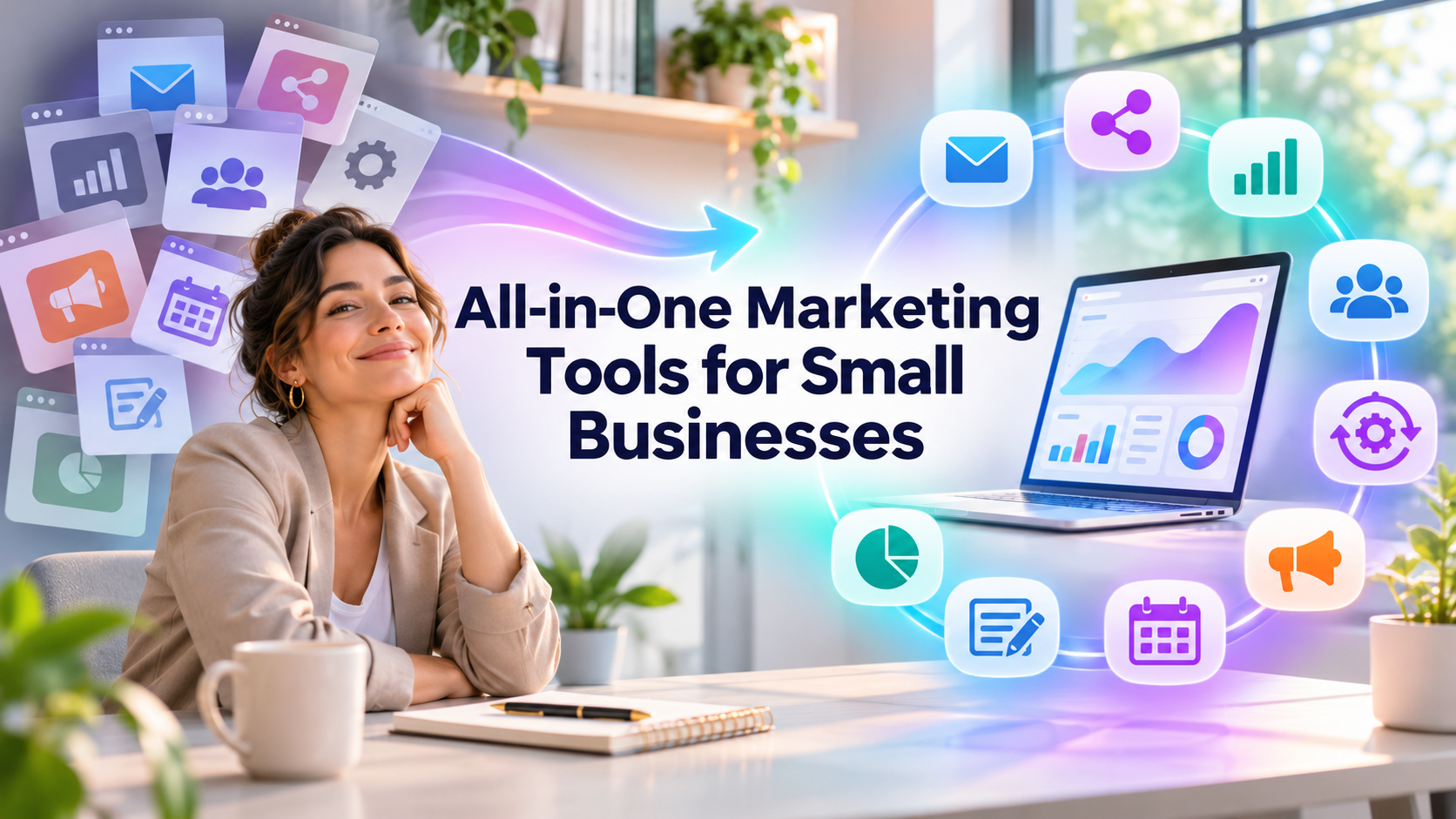
Quick answer: All-in-one marketing tools for small businesses should cover five jobs in one place: checking your website and social accounts, planning what to fix, creating and scheduling content, tracking results from Google and social platforms, and getting expert help when you need it. Choose one that is simple enough to use every week, priced for your stage, and connected to the accounts you already use.
Many small businesses end up with a pile of separate tools: one for social scheduling, one for SEO, one for analytics, one for design, a spreadsheet for planning and a chat group for updates. Each costs money and time, and none of them shows the whole picture. All-in-one platforms aim to fix that.
What Is an All-in-One Marketing Tool?
An all-in-one marketing tool is a single platform that brings several marketing tasks together, usually website and SEO checks, content and social media, analytics and reporting, and sometimes email, a CRM or access to experts. Instead of switching between apps, you plan, act and measure in one workspace.
Signs You're Using Too Many Tools
- You pay for several subscriptions but use only a few features of each
- You copy numbers between dashboards to answer "is our marketing working?"
- Different team members or marketers use different tools and nobody sees everything
- You forget which tool holds which login, report or draft
- Planning lives in a spreadsheet that's never up to date
Features That Matter Most
1. Website and SEO checks
The tool should check your site for common problems, such as missing titles and descriptions, slow pages, broken links and indexing issues, and tell you which to fix first.
2. Social media checks and publishing
Look for a way to review your social profiles, write posts once, preview them for each network and schedule them ahead.
3. Content creation
Blog and social content tools save time, especially if they keep everything in one calendar.
4. Analytics in one dashboard
It should connect to Google Analytics, Google Search Console and your social accounts, so you see traffic, search performance and social reach together.
5. Planning and priorities
The most useful tools don't just show data; they turn it into a short list of next steps.
6. Help when you need it
Some platforms connect you with marketers or agencies for the tasks you'd rather not do yourself.
What Small Businesses Often Don't Need (Yet)
- Complex automation built for large marketing teams
- Enterprise CRM features you won't set up
- Dozens of integrations you'll never connect
- Long annual contracts before you've tried the product
Pay for what you'll actually use in the next six months.
A Checklist Before You Choose
- Does it fix your biggest problem? Start from what's holding you back, not the longest feature list.
- Is it easy enough to use every week? Try it before you commit.
- Does it connect to your accounts? Website, Google Analytics, Search Console, Instagram, Facebook, LinkedIn.
- Is the pricing clear? Look for a free plan or trial and pricing in your currency.
- Do you own your data? You should be able to disconnect and keep your accounts.
- Is there support? Check how quickly you can get help.
- Can it grow with you? More accounts, more users or more businesses later.
All-in-One vs Separate Specialist Tools
Specialist tools can go deeper in one area, which suits large teams with dedicated roles. For most small businesses, the time saved and the single view of everything matter more than the deepest possible feature set. Many start with an all-in-one platform and add a specialist tool only when a specific need appears.
How DMB-One Works
DMB-One is an all-in-one growth platform built for small businesses. It gives you:
- A free website check covering on-page SEO, technical SEO, speed and search visibility
- A social check for Instagram, Facebook, LinkedIn and YouTube
- An AI diagnosis and a step-by-step growth plan
- Blog and social content tools with scheduling
- Google Analytics, Search Console and social metrics in one dashboard
- Matching with vetted marketers when you need help
It's free to start, with paid plans priced in rupees. Start free.
Frequently Asked Questions
Are all-in-one marketing tools worth it for small businesses?
Usually, yes, if you use at least three of the jobs it covers. The savings come from fewer subscriptions and less time switching between tools.
What's the most important feature?
The one that fixes your biggest problem. For many small businesses, that's a clear website and SEO check plus a plan of what to do next.
Can I start with a free plan?
Many platforms, including DMB-One, offer a free plan so you can test the core features before paying.
Will I lose my data if I switch?
Your website, Google and social accounts stay yours. Check what you can export before you sign up.
Do I still need a marketer if I use an all-in-one tool?
Not always. The tool shows what to fix; you can do it yourself or bring in a specialist for harder tasks.
Not sure what to fix first? Read How to Audit Your Website for SEO.