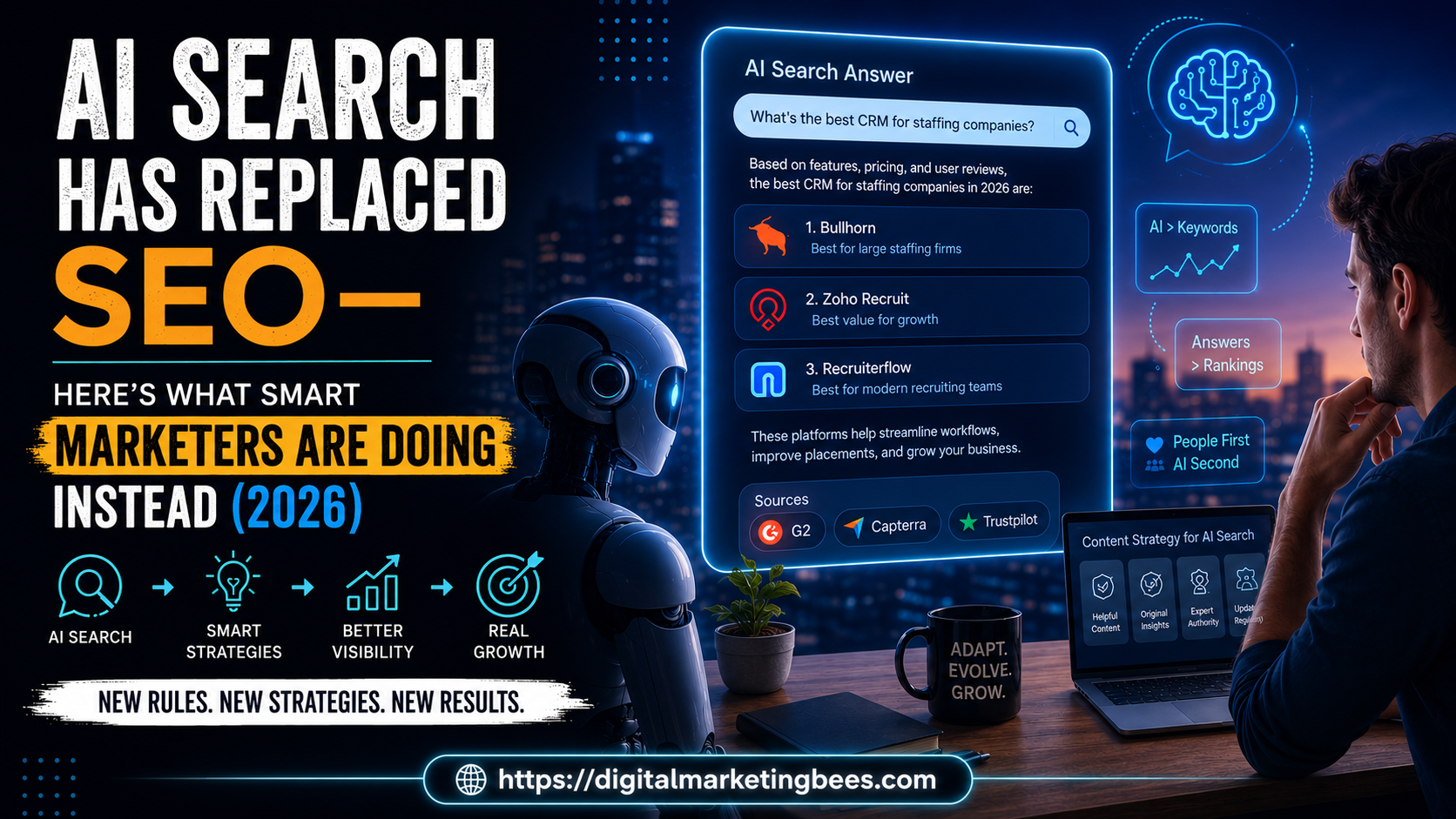
AI Search Optimization Has Replaced SEO—Here's What Smart Marketers Are Doing Instead (2026)
For nearly 25 years, marketers have played the same game.
Research keywords.
Write blog posts.
Build backlinks.
Wait for Google to rank them.
Watch traffic grow.
That strategy built billion-dollar businesses.
Today, it's no longer enough.
The biggest shift in digital marketing since the invention of Google Search is happening right now—and most businesses still don't realize it.
People are no longer searching the internet the way they did even two years ago.
Instead of typing:
"Best CRM software for staffing companies"
they now ask:
"I'm running a staffing agency with 30 recruiters. Which CRM should I choose and why?"
Instead of opening ten websites...
they expect one AI-generated answer.
And that's changing everything.
Welcome to the era of AI Search Optimization (ASO).
The Death of Traditional SEO (Not Literally... But Close)
Let's be clear.
SEO isn't disappearing.
It's evolving.
Google still indexes websites.
Bing still crawls pages.
Search engines still matter.
But something fundamental has changed.
Search engines are no longer the final destination.
They're becoming answer engines.
AI assistants like ChatGPT, Claude, Gemini, Perplexity, Copilot, and other AI-powered search platforms increasingly provide complete answers without users clicking through to websites.
That means:
Fewer clicks
Fewer page visits
Lower organic traffic
Higher competition for attention
For many websites, impressions are growing while actual traffic is declining.
If your strategy is only "rank #1 on Google," you're already behind.
Why AI Search Changes Everything
Traditional SEO rewarded pages that matched keywords.
AI rewards content that answers questions.
That's a massive difference.
Instead of asking:
"Does this page contain the keyword?"
AI systems ask:
Is this information trustworthy?
Is it complete?
Is it recent?
Does it explain the topic clearly?
Can I confidently summarize this content?
Those are entirely different ranking signals.
The winners aren't stuffing keywords.
They're becoming the best source of information.
The New Search Journey
Here's what search looked like a few years ago:
User → Google → Website → Conversion
Today's journey often looks like this:
User → AI Assistant → AI Summary → Decision
Sometimes your website is never visited.
Yet your content may still influence the answer.
That's why visibility is becoming more important than clicks.
What Smart Marketers Are Doing Instead
The companies winning in 2026 aren't abandoning SEO.
They're expanding beyond it.
Here are the strategies they're investing in.
1. Writing for Questions, Not Keywords
Old SEO:
"Best Project Management Software"
Modern AI optimization:
Which project management software is best for remote teams?
How does ClickUp compare with Monday.com?
What software works for startups under 20 employees?
Which platform offers the best automation?
AI loves direct answers.
Every section should solve one specific question.
2. Becoming the Original Source
AI systems prefer citing original research.
That means publishing:
Industry surveys
Internal data
Case studies
Customer success stories
Benchmarks
Reports
Experiments
Original content is far harder for competitors—or AI—to replace.
3. Building Topical Authority
Publishing 500 unrelated articles doesn't build authority anymore.
Publishing 50 deeply connected articles around one niche does.
For example, instead of writing about "marketing," focus on:
AI SEO
AI Search
GEO (Generative Engine Optimization)
Answer Engine Optimization
Content Automation
Semantic Search
Knowledge Graphs
When every article supports another, AI understands your expertise.
4. Creating Content AI Can Understand
Many websites still hide important information inside images, videos, or complicated layouts.
AI prefers clarity.
Use:
Clear headings
Short paragraphs
Bullet points
FAQs
Tables
Definitions
Comparisons
Step-by-step explanations
Readable content helps both humans and AI.
5. Updating Content Frequently
Freshness matters more than ever.
AI models increasingly prioritize recently updated information, especially for rapidly changing topics like marketing, software, technology, finance, and AI.
Instead of publishing 100 new articles every month...
Update your best-performing content regularly.
A continuously improved article often outperforms ten outdated ones.
6. Building Brand Authority
AI doesn't just evaluate webpages.
It evaluates brands.
Companies appearing consistently across:
News websites
Podcasts
YouTube
LinkedIn
Reddit discussions
GitHub (for technical companies)
Research publications
are more likely to be recognized as authoritative sources.
Brand mentions are becoming as valuable as backlinks.
7. Focusing on Expertise
Generic AI-generated content is everywhere.
The internet has become flooded with articles that say the same thing.
The winners are publishing insights that only real experience can provide.
Examples include:
Lessons learned from projects
Mistakes made
Real customer stories
Implementation challenges
Data-backed conclusions
Practical workflows
Experience creates differentiation.
The Biggest Mistake Businesses Are Making
Many companies think:
"AI can write 500 articles in one day."
Technically, yes.
Strategically, that's a disaster.
Publishing thousands of shallow articles no longer creates authority.
It creates noise.
Search platforms increasingly reward quality over quantity.
One exceptional guide often outperforms fifty average ones.
How to Future-Proof Your Website
If you want your content to remain discoverable over the next five years, focus on these principles:
✓ Solve real problems.
✓ Publish original insights.
✓ Build trust.
✓ Keep content updated.
✓ Demonstrate expertise.
✓ Answer specific questions.
✓ Create content that deserves to be referenced.
Those fundamentals will remain valuable regardless of how search technology evolves.
The Future Isn't Search. It's Answers.
We're witnessing one of the biggest shifts in the history of the internet.
SEO is no longer just about ranking pages.
It's about becoming the source AI trusts.
The businesses that adapt now will build visibility long before competitors catch up.
The businesses that don't may wonder why traffic keeps declining—even while publishing more content than ever.
The next generation of digital marketing belongs to organizations that optimize for people first and AI second.
Ironically, that's exactly what great SEO was supposed to be all along.
Final Thoughts
The question is no longer:
"How do I rank on Google?"
The better question is:
"Would an AI confidently recommend my content as the best answer?"
If the answer is yes, you're no longer competing for a search ranking.
You're competing to become the trusted source behind the answer.
And in 2026, that's where the real opportunity lies.
Frequently Asked Questions
Is SEO dead in 2026?
No. SEO is evolving rather than disappearing. Technical SEO, website performance, structured data, and high-quality content still matter, but success increasingly depends on creating content that AI systems trust and cite.
What is AI Search Optimization (ASO)?
AI Search Optimization focuses on making content understandable, trustworthy, and useful for AI-powered search engines and assistants so they can confidently reference it when generating answers.
Will AI reduce website traffic?
For many informational searches, yes. AI-generated summaries can reduce clicks. However, businesses that become trusted sources can gain higher-quality traffic, stronger brand awareness, and better-qualified leads.
What type of content performs best in AI search?
Content based on real experience, original research, expert opinions, case studies, statistics, tutorials, and comprehensive guides tends to perform better than generic keyword-focused articles.
Should I stop investing in SEO?
No. Continue investing in SEO while expanding your strategy to include AI Search Optimization, topical authority, brand building, and expert-driven content.